
The customer sees the trade counter. The risk runs through the whole operation.
Practical QHSE support for busy wholesale and trade environments.
DBIM supports merchants, wholesalers and trade businesses managing stock, customers, vehicles, yards, warehouses and operational premises. The focus is on controls that work from goods arriving at the gate to the customer leaving with the order.
Your employees know the site. Your customers often don't. Good trade-site design and working arrangements shouldn't rely on every visitor already knowing where vehicles move, where stock is handled or where it's safe to stand.
Good QHSE needs to work from the delivery gate to the customer leaving the site. That means looking at the whole operation rather than treating the yard, warehouse and counter as separate workplaces.
Yard. Warehouse. Trade counter. All part of the same operation.
A merchant or wholesaler can move from HGV deliveries and forklifts to manual picking and customer service within a few metres. Each area has its own risks, but people, vehicles and stock constantly move between them.
Yard
Delivery vehicles, customer vans, cars, forklifts and pedestrians can all need access to the same space. Layout and segregation need to make safe movement as obvious as possible.
Warehouse
Stock needs receiving, storing, picking and moving safely, often using racking, palletised storage and mechanical handling alongside manual work.
Trade counter
Employees and customers share a public-facing environment where products, collections, displays and movement need managing without making normal service unnecessarily complicated.
The boundaries aren't as neat as the floor plan.
A customer can arrive through the yard, walk to the counter and then return to a vehicle while employees are picking and loading the order. The safest arrangement is one where the customer doesn't need inside knowledge of the site to understand where to go.
Design for the person who has never visited before. Employees can be trained on site rules. Customers and visiting drivers need the layout, signage, barriers and working arrangements to make the safe route understandable from the outset.
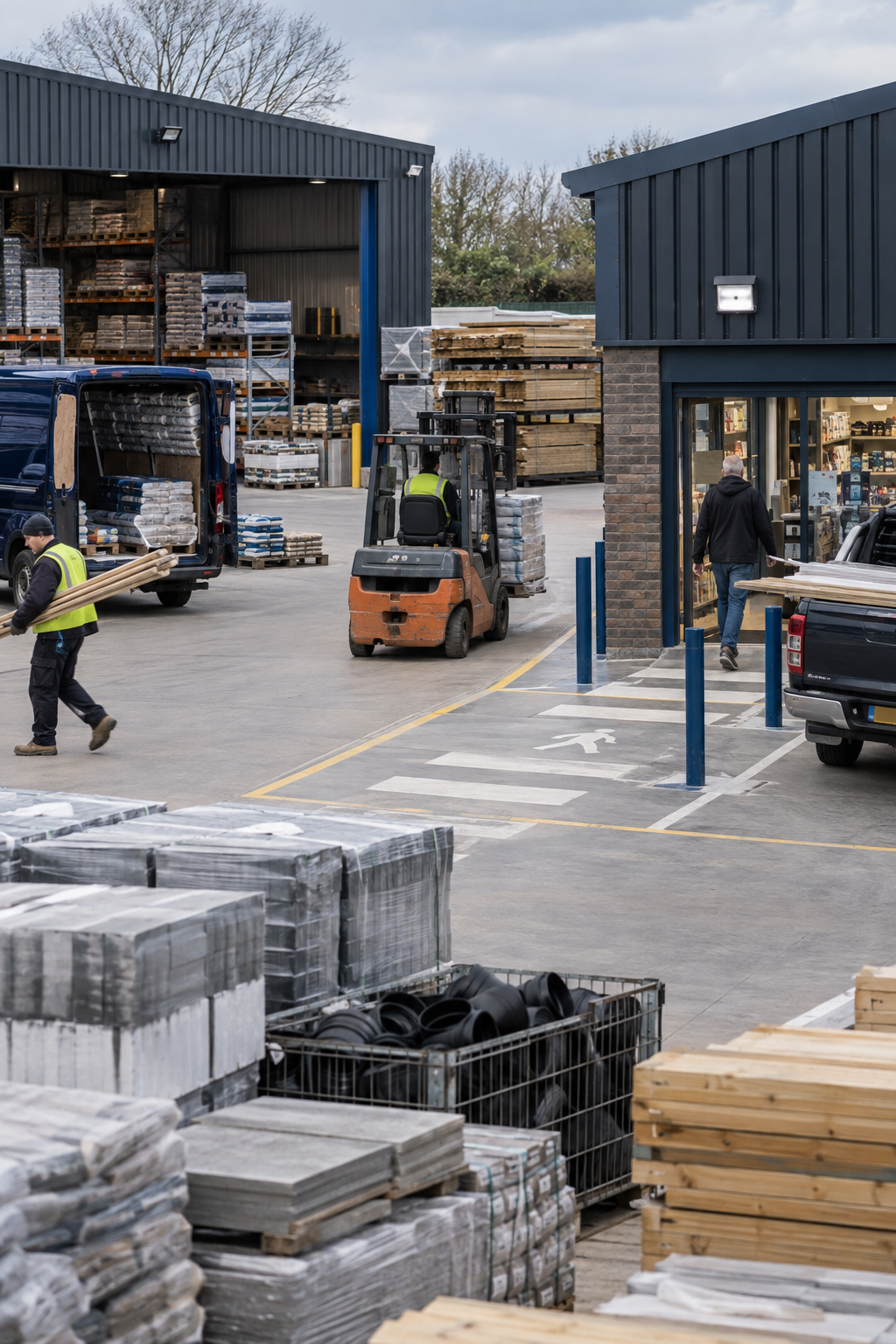
Customers don't automatically know your traffic-management plan.
Employees can be trained on pedestrian routes, forklift areas and loading arrangements. A trade customer arriving for the first time hasn't had that briefing. The site should help the customer make the safe choice without needing inside knowledge.
Is parking positioned so customers aren't immediately stepping into a vehicle route?
Are routes obvious, convenient and separated enough that people actually use them?
Can forklift movements be kept away from customers rather than relying mainly on everybody seeing each other?
Do delivery routes and timings reduce conflict with customer and employee movement?
Is it clear where customers should stand while employees or MHE load their order?
Can vehicles leave without unnecessary reversing, blind spots or crossing pedestrian routes?
The best reversing control can be needing less of it.
Start with the layout. One-way routes and drive-through arrangements can remove or reduce reversing before additional controls are needed.
Where reversing remains necessary, keep unnecessary pedestrians clear, make the area obvious and make sure visiting drivers understand the site arrangements.
Don't make the customer responsible for understanding a complicated yard. Where possible, design the site and collection process so the safe route is the easiest and most obvious route to follow.
Awkward matters as much as heavy.
Trade stock doesn't always arrive in a neat box with two handles. Long products, sheet materials, bags, drums and bulky components can create handling problems because of how they need to be moved, not simply what they weigh.
Weight
The physical effort involved still matters, particularly when loads are repeatedly lifted, carried or repositioned.
Bags · Drums · Boxes · ComponentsShape
Long, wide or irregular products can move the centre of gravity away from the body and make otherwise manageable weights difficult.
Timber · Pipe · Sheet · Long productsGrip
Smooth packaging, sharp edges, unstable contents or limited handholds can change the demands of the lift.
Packs · Sheet goods · Metal · ContainersFrequency
A manageable lift carried out repeatedly throughout a busy shift can create a very different level of exposure.
Picking · Replenishment · CollectionsDistance
Carrying distance, storage height and the route between the stock location and customer vehicle all influence the task.
Racking · Yard · Counter · VehicleEnvironment
Space, flooring, weather, lighting and congestion can turn a straightforward handling task into a more difficult one.
Yard · Aisles · Loading areas · WeatherWeight is only one part of the assessment. The task, frequency, posture, load characteristics, environment and individual capability all influence whether manual handling presents a significant risk.
Avoid
Can the hazardous manual handling be removed or designed out of the process?
Assess
Understand what makes the remaining task difficult rather than assessing the weight alone.
Reduce
Use mechanical help, improve storage and access, change the task or make the load easier to handle.
Manual-handling training isn't the first control. If the same awkward product is causing difficulty every day, start by looking at the stock, storage, equipment and process before relying on somebody remembering the perfect lifting technique.
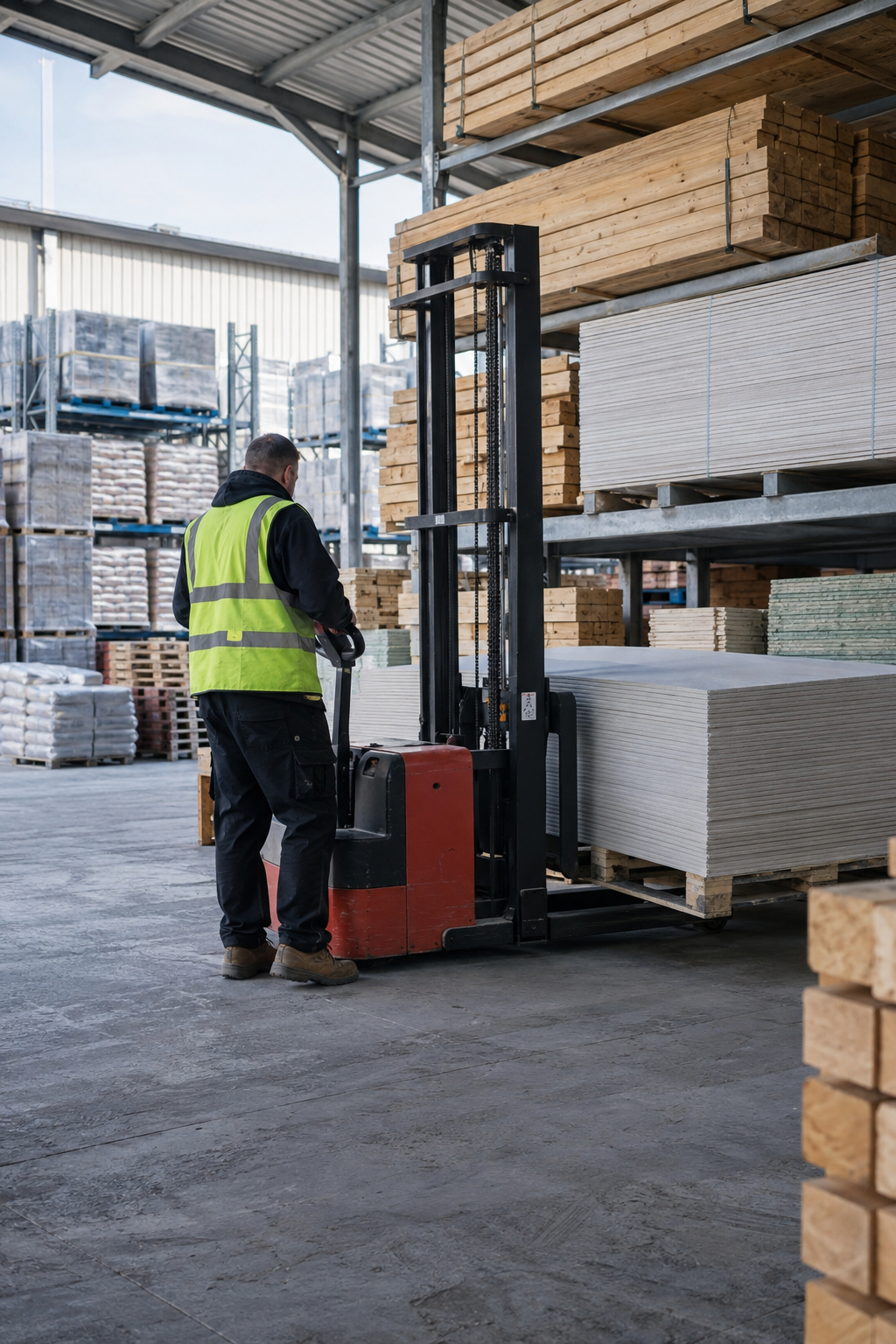
The job doesn't finish when the stock leaves the rack.
The final few metres can bring together stock, forklifts, employees, customers and vehicles in one relatively small space. A good collection process keeps that interaction controlled all the way through to release.
Pick
Select the right stock without creating unnecessary climbing, reaching, unstable storage or manual-handling problems.
Stock · Location · AccessMove
Use suitable handling equipment and keep the route between storage and collection areas clear and predictable.
FLT · MHE · PedestriansStage
Place orders somewhere stable and controlled while the customer and vehicle are prepared for collection.
Stability · Space · SeparationLoad
Keep customers and unrelated pedestrians clear while employees or mechanical equipment place the goods onto the vehicle.
Exclusion · Communication · StabilitySecure
Consider whether the goods are stable, suitably arranged and capable of travelling safely before release.
Position · Stability · RestraintRelease
Make sure people and handling equipment are clear before the customer vehicle re-enters the traffic route and leaves.
People · Vehicle · DepartureThe vehicle might belong to the customer.
A customer can arrive in anything from a suitable commercial van to a vehicle that makes the intended collection difficult. The collection process still needs limits.
Loading equipment, employees and customer expectations shouldn't turn an unsuitable or unstable collection arrangement into something the business quietly accepts just to complete the sale.
Keep unrelated traffic and pedestrians out of the loading operation.
Position the vehicle on suitable ground with movement controlled.
Match the handling equipment to the load and loading arrangement.
Everyone involved should know who is loading and where others should wait.
Don't let “the customer wants to take it” become the loading standard. Where an order can't be loaded or transported safely using the intended arrangement, the business needs a clear way to stop, change the method or agree another collection option.
What you stock changes what you need to control.
Not every merchant has the same risk profile. Timber, coatings, gas cylinders, aerosols and packaged components all create different considerations. The controls should follow the products actually passing through your business.
Adhesives, cleaners, paints, treatments and other chemical products can introduce employee exposure, spill, storage and disposal considerations.
Flammable liquids and aerosols can change storage, segregation, ventilation, ignition-control and emergency arrangements.
Compressed or liquefied gases bring stored-energy, impact, leakage, compatibility and fire considerations into the storage environment.
Long and bulky products shift the focus towards stable storage, handling equipment, access, manual handling and loading.
Smaller products may reduce individual handling demands but introduce high-frequency picking, storage and stock-management activity.
Leaks, broken packaging, damaged goods and waste can create risks that are quite different from stock sitting safely on the shelf.
What's actually on the shelf?
Don't create a generic COSHH or storage system and hope it fits everything. Understand the stock profile, quantities, hazards and how products are received, stored, picked, sold and eventually disposed of.
The stock profile should drive the controls. DBIM can help review the COSHH, storage, environmental and QHSE arrangements around the products you sell, while specialist chemical, fire, DSEAR or technical expertise remains with appropriately competent providers where the risk requires it.
Practical support from one issue to the whole system.
You might need an independent look at one busy yard, help standardising several branches or ongoing QHSE capability behind the operation. DBIM can scale the support around the problem rather than forcing the business into a fixed consultancy package.
Check.
Understand what's working, where the gaps are and what genuinely needs attention before creating another action list.
Fix.
Improve practical controls around the yard, stock handling, workplace transport, COSHH, contractors and actions.
Standardise.
Build common ways of working across branches while leaving room for the different layouts, products and risks at each site.
Support.
Add competent advice or regular QHSE capacity when the internal team needs more support than it can comfortably provide.
Suppliers, stock accuracy, errors, returns, complaints and customer-service performance.
Packaging, waste, fuel, energy, spills and wider environmental performance.
People, vehicles, handling, hazardous products and everyday operational controls.
For businesses already managing day-to-day Health & Safety internally, the Advice Line provides competent support when questions arise plus an annual H&S Health Check.
The objective isn't to turn a trade business into a paperwork business. The systems should make yards, branches and customer service easier to manage consistently, while keeping the important risks visible.
Different products. Similar operational pressures.
DBIM is best suited to wholesale and trade businesses where stock, people, vehicles and customers all form part of the same operational environment, and where practical QHSE support needs to work around the way the branch actually trades.
Builders' merchants
Yard, warehouse and trade-counter operations managing bulky stock, customer collections, workplace transport and regular deliveries.
Industrial distributors
Businesses supplying engineering parts, equipment, consumables and specialist products into operational customers.
Electrical wholesalers
Trade-counter and warehouse environments balancing high-frequency picking, stock management, customers and deliveries.
Plumbing & heating merchants
Mixed-stock operations handling long products, packaged goods, cylinders, chemicals and customer collections.
Timber & building-product suppliers
Operations managing large, long or awkward products where storage, mechanical handling and safe loading become central.
Multi-site trade groups
Businesses that need consistent QHSE expectations across branches without ignoring the different layouts, stock and risks at each location.
Operational enough to understand the branch. Structured enough to improve the system.
DBIM comes from an operational QHSE and improvement background. That means looking beyond the policy folder at how vehicles move, how stock is handled, how customers interact with the site and how consistently the business works across people and locations.
Standardise the important things, not every tiny detail. A good group framework can set common expectations for workplace transport, COSHH, inspections, incidents and actions while each branch still manages the risks created by its own layout and stock.
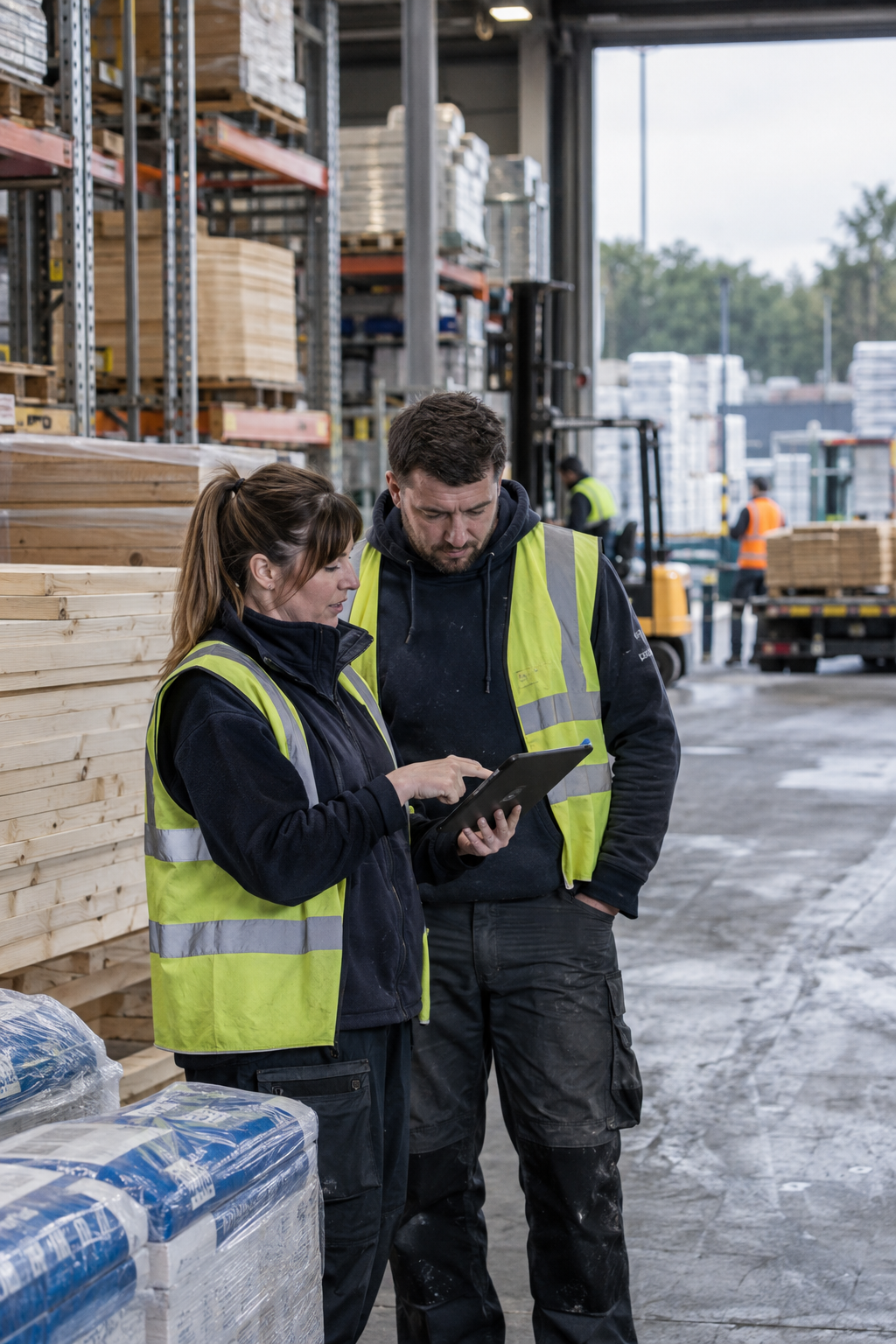
What needs sorting in the operation?
You don't need to choose the consultancy service first. Start with what isn't working, what keeps creating concern or what has become difficult to manage consistently.
Customers, pedestrians, forklifts and vehicles are sharing space and too much of the control depends on awareness rather than the site arrangement itself.
You want an independent view across yard, warehouse, trade counter and supporting arrangements before deciding what needs attention first.
Bulky, long, repetitive or awkward stock is creating strains, near misses or workarounds that need a closer look.
You need common expectations for inspections, incidents, workplace transport, COSHH and actions without forcing very different branches into identical processes.
Day-to-day arrangements are handled internally, but unusual situations or questions occasionally need experienced, competent advice.
Actions, audits, systems and improvement need more consistent input than the existing team can comfortably provide.
Tell us what's creating friction.
You don't need to diagnose the solution before contacting DBIM. Tell us what you're seeing in the branch, yard or wider group. We'll ask the questions and suggest a proportionate place to start.
What's creating friction in the operation?
Customers and forklifts crossing paths. Stock that's difficult to handle. Loading arrangements that depend too much on judgement. Branches working in different ways. Or actions that never quite seem to close. Start with what's happening in the real operation.
Tell us what isn't working as well as it should.
No hard sell and no generic safety package. We'll start with the yard, warehouse, trade counter or wider branch network as it actually operates, then help identify a practical and proportionate next step.