
Most office risks don't look particularly dramatic. That doesn't mean they should be ignored.
Proportionate Health & Safety for modern ways of working.
DBIM supports office-based and hybrid businesses with DSE, workplace arrangements, work-related stress, competent advice and practical QHSE systems. The aim is to cover what matters without turning ordinary office work into an unnecessary rulebook.
Office Health & Safety shouldn't feel heavy. It should quietly make sure people have a safe place to work, suitable equipment, sensible support and clear arrangements when something needs attention.
And when work happens across the office, home and other locations, the management system needs to follow the work rather than stopping at the office door.
Office. Home. Hybrid. The responsibility travels with the work.
Work no longer happens at one desk in one building. People may split the week between an office, home and other locations. The arrangements need to stay proportionate while still covering the people doing the work.
Office
Shared desks, meeting rooms, circulation areas, welfare and everyday workplace arrangements remain the visible part of office Health & Safety.
Home
Home working changes how risks are identified and supported. DSE, equipment condition, the work area, communication, emergencies and working alone still need consideration.
Hybrid
Hybrid working is less about creating another set of rules and more about making sure important controls don't disappear when somebody changes location.
Employers still have Health & Safety responsibilities when people work from home. That doesn't usually mean inspecting everybody's spare bedroom. It means having sensible ways to assess, communicate, support and act on risks wherever work happens.
The answer isn't to reproduce the office inside everybody's home. It's to identify the significant risks of the work, provide suitable support and make it easy for people to raise issues wherever they are working.
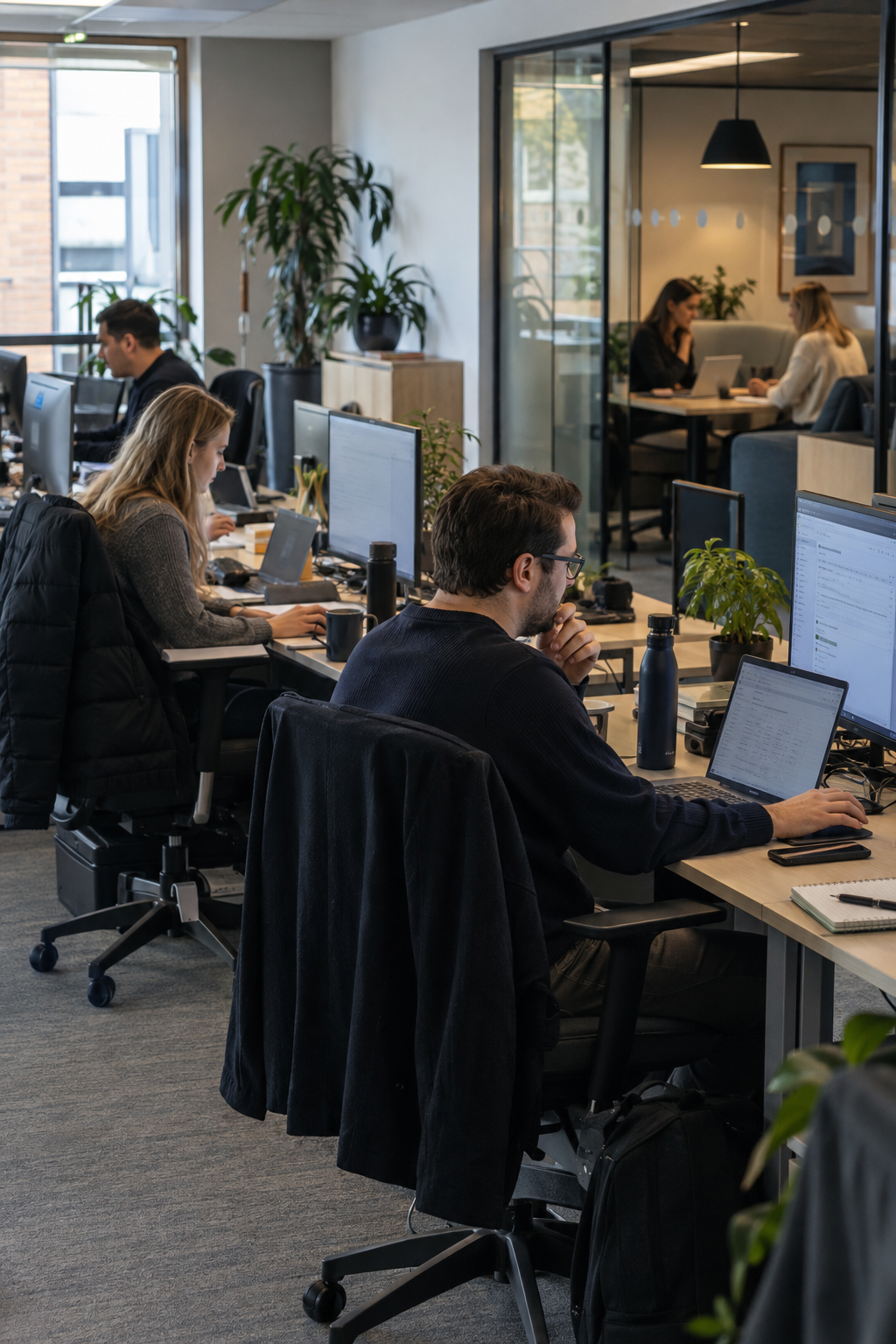
The perfect workstation on paper doesn't help if nobody works that way.
DSE shouldn't be reduced to completing a checklist once and filing it away. The useful question is whether the person can work comfortably, adjust the setup and get problems dealt with when something isn't right.
Screen
Position, viewing comfort, glare and the practical difference between a proper screen setup and prolonged laptop-only working.
Chair
Suitable seating needs to support the individual and allow adjustment rather than simply being labelled an office chair.
Input
Keyboard and pointing devices should support a comfortable working position without unnecessary reaching or tension.
Desk
There needs to be enough usable space to arrange equipment and work without poor positioning becoming the default.
Environment
Lighting, reflections, temperature and the surrounding workspace all influence whether the setup remains comfortable.
Movement
The answer isn't one perfect posture held for eight hours. Work should allow regular changes of position or activity.
The assessment should lead somewhere.
A completed DSE form isn't the outcome. If the assessment identifies discomfort, unsuitable equipment or another practical issue, there needs to be a sensible route to adjust the setup and close the action.
Assess
Understand the workstation, task and person using it.
Adjust
Change the setup where simple adjustments resolve the issue.
Act
Provide equipment or further support where the assessment identifies a need.
Review
Revisit the arrangement when circumstances change or problems arise.
Flexibility still needs adjustability. Where people regularly move between desks, make it easy to adjust the workstation and carry out the basic checks needed at the desk being used that day.
DSE management should solve problems, not just record them. That applies whether somebody has a permanent office desk, regularly hot-desks or splits the week between office and home.
Wellbeing isn't just fruit bowls and Friday yoga.
Employee wellbeing initiatives can be useful, but they don't replace managing the things within work that can contribute to work-related stress. Sometimes the better place to start is the workload, role, support or way change is being managed.
Demands
Look at workload, deadlines, work patterns and whether people have the time and resources to meet reasonable expectations.
Workload · Deadlines · Hours · EnvironmentControl
Consider how much appropriate influence people have over the way they organise and carry out their work.
Autonomy · Pace · Methods · FlexibilitySupport
Make sure people know where to get information, resources, help and constructive support from managers and colleagues.
Resources · Managers · Colleagues · FeedbackRelationships
Promote positive working relationships and have clear ways to address conflict, bullying and unacceptable behaviour.
Behaviour · Conflict · Respect · EscalationRole
People should understand what they're responsible for and avoid being pulled between conflicting expectations.
Clarity · Priorities · ResponsibilitiesChange
Organisational change needs to be planned, explained and communicated rather than simply announced after decisions are made.
Consultation · Communication · TransitionSupport people. Manage the work too.
Employee assistance, wellbeing initiatives and individual support can all have a place. But they shouldn't become substitutes for dealing with unreasonable demands, unclear roles, poor communication or other problems created by the way work is organised.
Listen
Use employee input alongside existing information to understand concerns.
Assess
Look for patterns and underlying work factors rather than assumptions.
Improve
Agree practical changes to the work or management arrangements.
Review
Check whether the actions have actually improved the situation.
DBIM can help businesses establish a proportionate process for assessing and managing work-related stress risks, including management arrangements, consultation and actions. Individual diagnosis, treatment and clinical mental-health support belong with appropriately qualified healthcare professionals.
Don't try to diagnose stress from how somebody looks or behaves. Focus on creating ways for people to raise concerns and managing the work factors that the organisation can actually influence.

Nobody notices most workplace controls until they're missing.
Good office Health & Safety is often quietly uneventful. People can get in, work comfortably, move around, use the facilities and know what to do if something goes wrong. That's exactly the point.
Open
Access, lighting, shared areas and the workplace are ready for people to use safely.
Work
Equipment, welfare, temperature and everyday workplace arrangements support normal activity.
Meet
Employees, contractors and visitors can use the workplace without unclear responsibilities or avoidable disruption.
Move
Walkways, stairs, doors and shared spaces remain clear, suitable and properly maintained.
Close
Out-of-hours work, security, lone working and emergency arrangements still make sense when the office empties.
Workplace condition
Floors, stairs, doors, access routes and shared areas kept suitable for normal use rather than waiting for defects to become incidents.
Environment & welfare
Suitable lighting, temperature, ventilation, drinking water, toilets and rest arrangements supporting the people using the workplace.
Electrical equipment
Sensible arrangements for condition, use, defects and maintenance rather than treating every plug as a paperwork exercise.
Fire & emergencies
People understand the arrangements, escape routes remain usable and changes to occupancy or layout don't quietly undermine the plan.
First aid
Provision reflects the people, workplace, working patterns and needs of the organisation rather than simply buying a kit.
Visitors & contractors
People entering the workplace receive the information and arrangements relevant to what they're actually there to do.
Would the arrangements still work when the office is quiet?
Hybrid work can mean lower occupancy, different attendance patterns and people working outside normal hours. Fire, first-aid and emergency arrangements need to reflect the workplace that actually exists, not the headcount printed on the organisation chart.
Working alone isn't automatically unsafe. But the risks need managing before people work without close or direct supervision, including how they communicate and how help would be provided if something went wrong.
The basics should be dependable, not burdensome. Once these everyday arrangements work properly, Health & Safety can sit quietly in the background rather than becoming something employees have to think about every time they walk into the office.
People don't all arrive with the same experience.
A workplace that feels completely familiar to somebody who has been there for five years can feel very different on day one. Good arrangements recognise experience, familiarity and capability rather than assuming everybody starts from the same place.
Recruit
Consider the work, responsibilities and any particular capability or support requirements relevant to the role.
Induct
Explain the workplace, responsibilities, emergency arrangements, reporting routes and what people are expected to do.
Equip
Provide the information, equipment and practical arrangements needed to carry out the work safely.
Support
Give people somewhere to ask questions and enough supervision while the role and workplace are still unfamiliar.
Review
Revisit arrangements when the role, location, equipment or person's circumstances materially change.
New starters
The business, workplace, emergency arrangements and reporting routes may all be unfamiliar even when the role itself isn't.
Young workers
Less workplace experience or maturity can affect familiarity with risk, asking questions and understanding what's expected.
Temporary workers
Shorter assignments don't remove the need for relevant information, induction and clarity over responsibilities.
Remote starters
Joining from home can remove some of the informal workplace familiarisation that usually happens naturally around colleagues.
Changed roles
A long-serving employee can still be inexperienced when responsibilities, equipment or ways of working change.
Returning workers
A return following extended absence may need refreshed information, updated arrangements or reasonable adjustments depending on the circumstances.
What doesn't this person know yet?
Don't mistake intelligence or professional experience for familiarity with your workplace. A highly experienced new employee can still not know how incidents are reported, what the fire arrangements are or who to contact when something doesn't look right.
Induction isn't the finish line. The useful outcome is somebody who understands what is expected, knows where to find information and feels able to ask when they aren't sure.
Enough support to be confident. Not more process than you need.
Most office-based SMEs don't need a complicated Health & Safety management structure. They need clear responsibilities, sensible arrangements and competent support available when something falls outside the everyday.
Keep it simple.
Put the basics in place and make sure the arrangements reflect how people actually work across the office and home.
Make it consistent.
Strengthen responsibilities, audits, actions and common arrangements where teams, offices or ways of working have grown.
Build it further.
Develop formal QHSE management systems where the organisation has certification, client, environmental or wider improvement objectives.
Competent Person Advice Line
If the business already handles everyday Health & Safety internally, you may not need regular consultancy visits. You may simply need competent advice available when questions arise, backed by an annual H&S Health Check.
Energy, waste, travel, procurement, environmental objectives and wider organisational impacts.
Risks, consultation, responsibilities, objectives, incidents and continual improvement.
Not every office needs a full-time Health & Safety Manager. Every employer still needs sensible arrangements and access to appropriate competent help. DBIM can sit behind the team without becoming another layer of bureaucracy.
Sensible support for businesses that don't need a safety department.
DBIM is particularly suited to office-based SMEs where Health & Safety is managed alongside another role and the business wants competent support without creating unnecessary complexity.
Professional services
Consultancies, accountants, agencies and other office-based SMEs needing straightforward, proportionate H&S arrangements.
Technology businesses
Screen-based and hybrid teams where DSE, home working, growth and changing ways of working need sensible oversight.
Head offices
Office teams attached to manufacturing, logistics or other operational businesses where corporate and operational risks differ.
Growing SMEs
Businesses where Health & Safety developed informally when the team was small and now needs slightly more structure.
Hybrid businesses
Teams working between office and home that need consistent arrangements without treating remote work as a separate universe.
Multi-office businesses
Organisations needing common expectations across locations while recognising differences in occupancy, buildings and ways of working.
Proportionate enough for the office. Structured enough for the business.
DBIM brings practical QHSE and management-system experience without assuming every office needs an industrial-style safety programme. The focus is on getting the important arrangements right, making responsibilities clear and giving the business somewhere competent to turn when it isn't sure.
Not every office needs a full-time Health & Safety Manager. A lot of businesses simply need somebody internally to own the basics, supported by competent advice and an independent check that nothing important has been missed.

What's sitting in the workplace inbox?
Health & Safety in an office often lands with somebody who already has another job to do. Start with the question that's been sitting unanswered, the process that's fallen behind or the area you're simply not confident about.
That's completely fine.
You don't need to diagnose the Health & Safety solution before contacting DBIM. Tell us what you're unsure about, what's changed or what keeps getting pushed down the list. We'll help identify a sensible and proportionate place to start.
Health & Safety doesn't need to dominate the workplace.
It just needs to work. If you're unsure whether the basics are covered, hybrid working has created gaps, an office issue keeps being pushed down the list or Health & Safety has simply landed with somebody who could use competent backup, start there.
What are you not completely confident about?
No hard sell and no industrial-style safety system shoehorned into an office. We'll start with how your people actually work and help identify the level of support that genuinely makes sense.