
A busy workshop has more going on than the vehicle on the ramp.
Practical QHSE support built around how workshops actually operate.
DBIM supports garages, bodyshops, fleet workshops and vehicle-maintenance businesses with Health & Safety, COSHH, work equipment, ISO systems and ongoing QHSE improvement. The focus is on controlling the workshop around the job, without creating paperwork that gets in the way of doing it.
Safe workshops are built around the whole job. The vehicle, technician, equipment, substances, working environment and pressure to get the job finished all interact with each other.
One workshop. Multiple risk environments.
A vehicle workshop can move from lifting a two-tonne vehicle to welding, tyre inflation, chemical cleaning and engine testing within a few metres. The risks change with the job, even when the people and building stay the same.
Workshop floor
Vehicles, technicians, tools and equipment all move through the same working space. Layout, housekeeping and workshop traffic influence how safely that interaction happens.
Movement · Access · Slips · Work equipmentUnder the vehicle
Lifts, jacks, axle stands and inspection pits put people beneath significant loads where equipment condition, correct use and vehicle stability become critical.
Lifting · Stability · Support · InspectionHot work
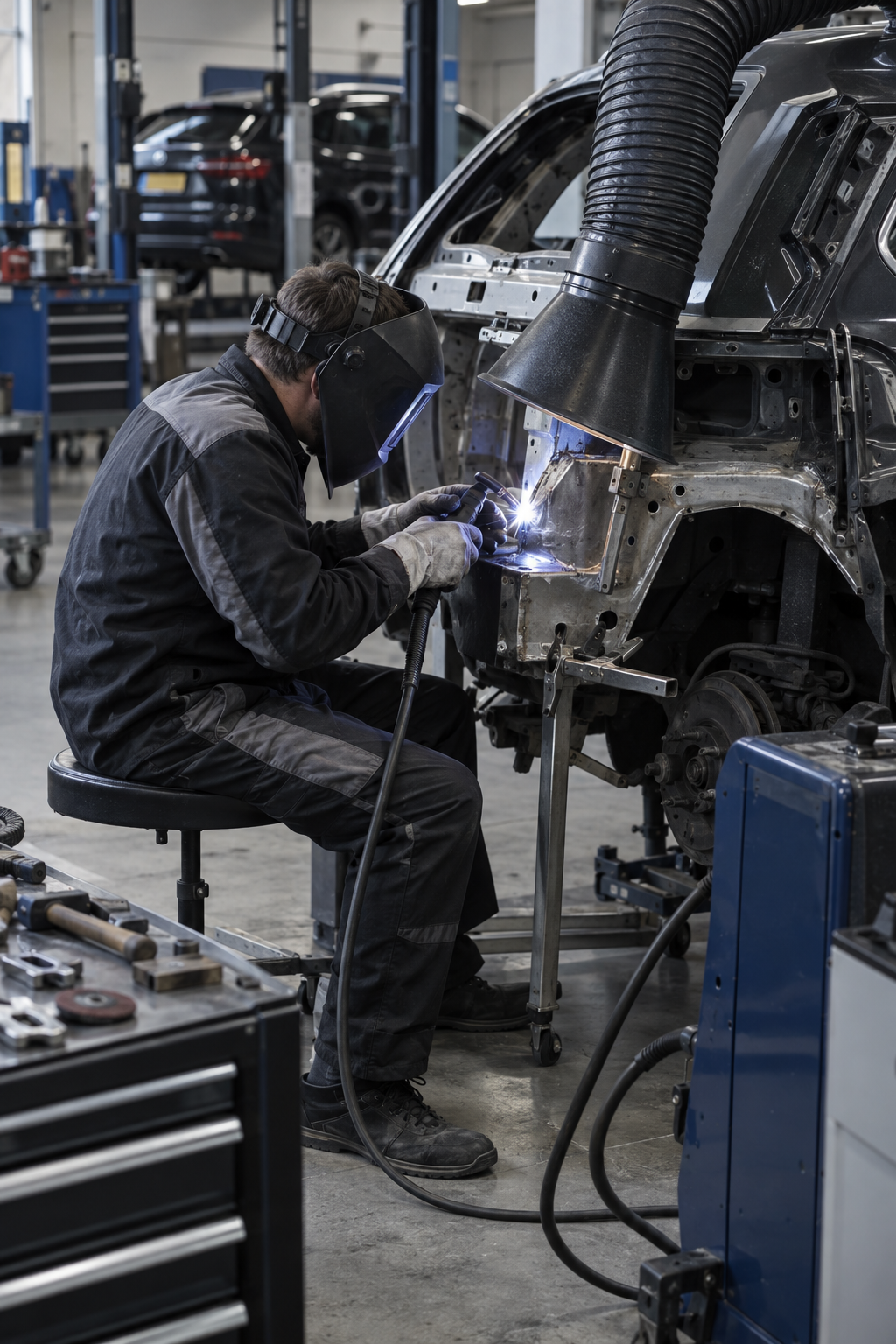
Welding, grinding and cutting introduce heat, sparks, fumes, ignition sources and additional controls around nearby vehicles and materials.
Welding · Fire · Fume · IgnitionFluids & substances
Oils, fuels, cleaners, coolants, brake fluids, paints and other products create skin, inhalation, fire and environmental considerations.
COSHH · Skin · Storage · Spill controlTyres & wheels
Removal, handling and inflation involve heavy components and stored energy that can make familiar tasks unexpectedly hazardous.
Inflation · Stored energy · HandlingExhaust & emissions
Running engines indoors can introduce exhaust gases into the workshop, making effective control and extraction important.
Exhaust · Ventilation · ExposureGood workshop safety isn't six separate systems. The controls need to work together around the technician, the vehicle and the job being carried out.
Familiar work still deserves proper control. Many workshop activities happen every day, which can make hazards easier to normalise rather than easier to manage.
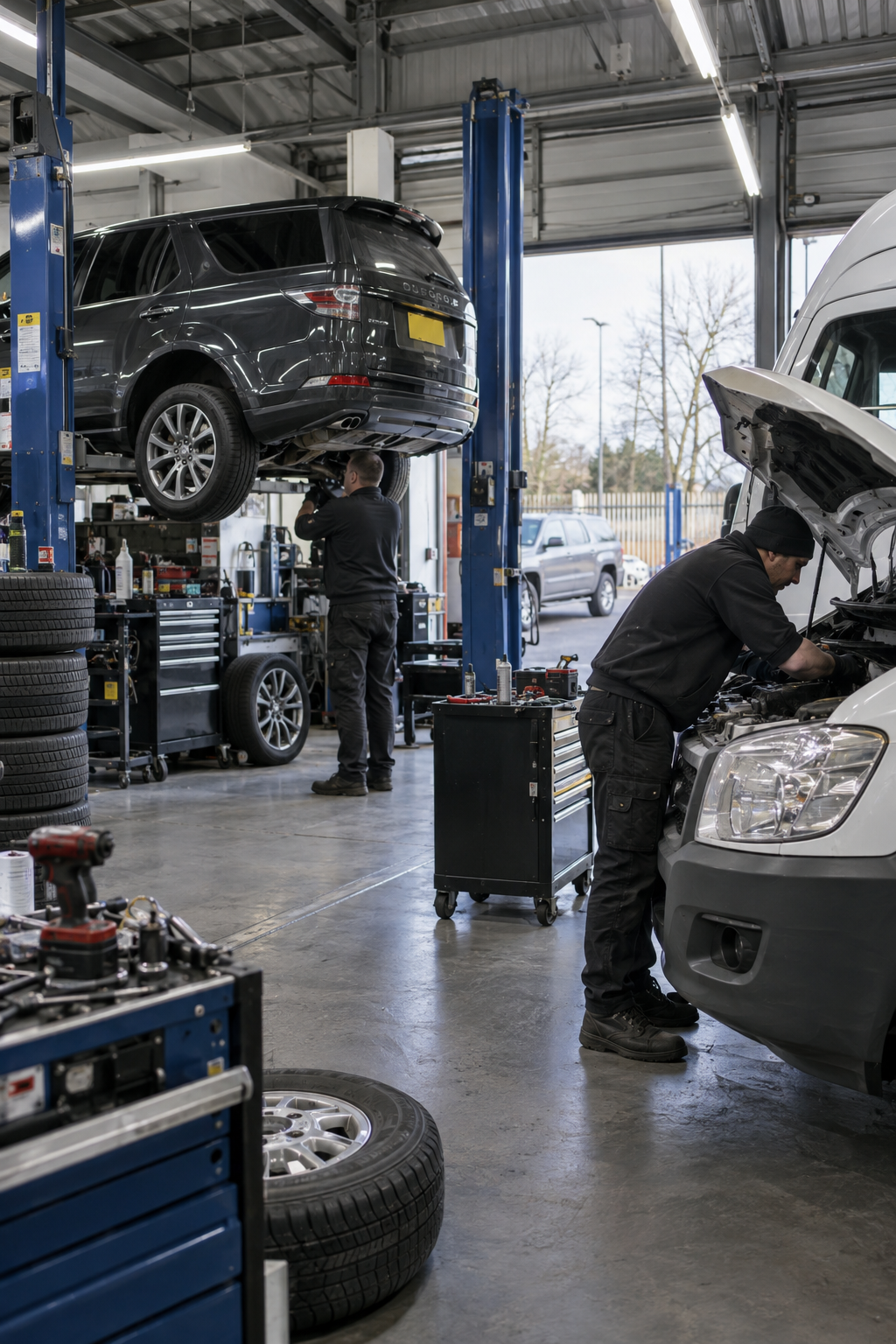
If somebody is underneath it, “probably secure” isn't good enough.
Vehicle lifts, jacks and support equipment make routine repair work possible, but they also put technicians beneath significant loads. Stability needs to be established before the work starts and protected while the job changes.
Lift it safely. Keep it stable.
Correct lifting points, equipment capacity and condition all matter, but so does what happens to the vehicle once work begins. Removing major components or applying significant force can change weight distribution and stability.
Lift
Use suitable equipment within its intended capability.
Position
Use the correct vehicle lifting or jacking points.
Check
Confirm pads, arms, locks and vehicle position before full elevation.
Support
Use the correct additional support where the task requires it.
Work
Keep considering stability as components and forces change.
Lower
Clear the area and return the vehicle deliberately and safely.
Removing an engine, gearbox, battery pack or other substantial component can materially change weight distribution.
The same applies when significant force is introduced during seized or difficult repair work. Stability needs considering as the task develops, not only when the lift first goes up.
DBIM can help review the management arrangements around workshop lifting equipment and safe working practices. Lift installation, technical examination, repair and engineering decisions still need appropriately competent specialist providers.
Not every workshop injury happens suddenly.
Some workshop risks build quietly through repeated exposure. Exhaust fumes, welding fume, oils, solvents, dust, noise and vibration can affect people long before there's an obvious incident. Good workshop safety has to protect long-term health too.
Breathe
Control airborne contaminants at source rather than relying on workshop size, open doors or PPE alone.
Exhaust · Welding fume · Dust · Paint mistTouch
Repeated contact with oils, fuels, cleaners, solvents and other workshop products can affect skin health.
Oils · Fuels · Cleaners · SolventsHear
Impact tools, grinders, compressed-air equipment and other workshop activities can create cumulative noise exposure.
Tools · Grinding · Compressed air · MachineryFeel
Frequent powered-tool use can introduce vibration alongside the physical demands of repetitive workshop work.
Vibration · Repetition · Manual handlingAn open workshop door isn't an exhaust extraction system.
Vehicle exhaust can quickly reach harmful concentrations indoors. Where engines need to run statically, suitable tailpipe extraction and effective workshop ventilation should form part of the control strategy.
DBIM can help review the COSHH and QHSE arrangements around workshop exposure. Occupational hygiene monitoring, health surveillance, LEV examination and other specialist technical services should remain with appropriately competent providers where required.
If you spray 2K paint, the invisible part matters most.
Isocyanate-containing two-pack paints can create an invisible spray mist capable of causing occupational asthma and dermatitis. Good control is about the whole process, not simply putting on respiratory protection when the spray gun comes out.
Isocyanates are a major cause of occupational asthma. Once somebody becomes sensitised, even small exposures can trigger serious symptoms. Minimising exposure needs to be built into the bodyshop process.
Mix
Control exposure while mixing products and understand the substances and hardeners being used.
Spray
Spray within a suitable extracted booth or room using the required air-fed breathing equipment and work arrangements.
Clear
Allow the booth or room to complete its measured clearance time before respiratory protection is removed or others enter.
Clean
Gun cleaning and related tasks can still create exposure, so the control arrangements need to cover them too.
Verify
Use health surveillance and biological monitoring where required to check that exposure controls remain effective.
Spraying stops before the exposure stops.
Spray booths and rooms take time to remove airborne mist after spraying ends. The clearance time needs to be measured, clearly communicated and actually followed.
Air-fed breathing apparatus should remain in use while spray mist is still present, rather than the visor being raised as soon as the spray gun stops.
Maintain suitable extraction and know the booth's actual clearance time.
Use suitable air-fed breathing apparatus while isocyanate mist is present.
Use appropriate health surveillance and biological monitoring to check controls are protecting people.
DBIM can help review COSHH assessments, responsibilities, procedures, training arrangements, actions and the wider bodyshop QHSE system. Occupational health surveillance, biological monitoring, exposure measurement and specialist booth or RPE technical services should remain with appropriately competent providers.
Familiar jobs can still have serious consequences.
Some workshop activities happen so often that it's easy for shortcuts, workarounds and accepted habits to become normal. Frequency doesn't make the risk disappear. It makes consistent control more important.
Vehicle movement
Customer vehicles, workshop movements, reversing and limited visibility all need controlling around technicians and visitors.
Tyres & inflation
Tyres contain significant stored energy. Condition, inflation technique, equipment and where people stand all matter, particularly where damage or underinflation may have weakened the tyre.
Compressed air
Useful workshop equipment can become hazardous when hoses, fittings, pressure or everyday behaviour aren't properly controlled.
Batteries
Charging, handling and electrical work can introduce chemical, electrical and ignition risks that vary significantly with vehicle technology.
Housekeeping
Hoses, leads, removed components, spillages, tools and waste can quickly turn normal access around a busy vehicle into an obstacle course.
Fire & ignition
Fuels, batteries, flammable products and hot work can coexist within a relatively small workshop, making storage and ignition control part of everyday management.
Modern workshops increasingly encounter electric and hybrid vehicles. The principle remains competence before intervention. High-voltage systems, damaged batteries and isolation arrangements need the right technical knowledge rather than assumptions based on conventional vehicle experience.
Watch what becomes normal.
Workshops develop shortcuts because experienced people solve problems quickly. Sometimes that's expertise. Sometimes it's a workaround that's survived long enough to stop looking unusual.
DBIM's role isn't to tell technicians how to repair vehicles. It's to help the business identify where everyday workshop practices need clearer controls, better ownership or specialist technical input.
You know the vehicles. We strengthen the system around the work.
Your technicians bring the automotive expertise. DBIM brings an operational QHSE perspective around workshop risk, work equipment, COSHH, management systems, actions and continual improvement.
Inspect.
Step back from the day-to-day and identify where workshop arrangements are strong, where gaps exist and what should be prioritised first.
Control.
Strengthen practical arrangements around lifting equipment, COSHH, hot work, workplace transport, contractors, incidents and everyday workshop activities.
Systemise.
Turn separate workshop controls into a management system that gives responsibilities, evidence, audits and improvements somewhere sensible to live.
Support.
Add competent advice or ongoing QHSE capability when the workshop needs more support than the existing team can comfortably provide.
ISO 9001 can connect workshop control to customer performance. Workmanship, inspection, calibration, parts and suppliers, damaged vehicles, rework, complaints and corrective action all affect how consistently the workshop delivers.
If the workshop already handles day-to-day Health & Safety, you may simply need competent advice available when questions arise plus an annual H&S Health Check.
The objective isn't more workshop paperwork. It's making the important controls easier to understand, maintain, evidence and improve, while specialist automotive, engineering and occupational-health expertise stays with the appropriately competent people.
Different workshops. Similar QHSE challenges.
DBIM is best suited to automotive and vehicle-maintenance businesses that already understand the technical work but need stronger Health & Safety, Quality, Environmental or management-system support around the operation.
Independent garages
Busy servicing, repair and MOT environments where workshop Health & Safety often sits alongside another management role.
Commercial vehicle workshops
HGV, van and specialist fleet operations dealing with larger vehicles, heavier components and demanding maintenance activity.
Bodyshops
Repair and refinishing operations where COSHH, paint systems, exposure control and occupational health need active management.
Fleet workshops
In-house maintenance teams supporting a wider vehicle operation, where workshop safety and fleet reliability are closely connected.
Vehicle preparation centres
High-throughput preparation, inspection, refurbishment and rectification operations balancing consistency with turnaround.
Multi-site workshop groups
Organisations needing common QHSE standards across locations without ignoring the different equipment and work at each site.
Workshop-aware without pretending to be the technician.
DBIM's background is operational QHSE, manufacturing and continual improvement. That gives us a practical understanding of work equipment, hazardous substances, workshop behaviour, ISO systems and how controls need to work around real operational pressure.
Your technicians own the vehicle expertise. DBIM helps strengthen the QHSE environment around that work and recognises when lift engineering, occupational hygiene, EV/high-voltage, occupational health or other specialist technical competence is required.
What's sitting on the workshop job board?
You don't need to know which consultancy service you need. Start with what keeps causing concern, what has fallen behind or what the workshop needs to improve next.
You want an independent look across the workshop rather than waiting for an incident, customer requirement or inspection to tell you what has been missed.
Products, equipment or working practices have changed and the paperwork no longer reflects what technicians are actually doing.
You need to look beyond the latest event and understand whether equipment, layout, supervision, behaviours or systems are contributing to a wider pattern.
You want to review the COSHH management system around products, spraying, procedures, responsibilities, training and specialist occupational-health controls.
The workshop handles the normal day-to-day arrangements but occasionally needs competent advice, reassurance or an experienced second opinion.
The operation needs regular QHSE input, action management, audits or improvement capacity beyond what the current team can comfortably absorb.
Put it on the board anyway.
Workshop problems rarely arrive with the name of the consultancy service required to fix them. Tell us what's happening, what keeps repeating or what you're worried about. We'll help identify the sensible next step and whether DBIM is the right fit.
What's happening in the workshop?
A recurring incident. COSHH that's fallen behind. A lifting arrangement you're unsure about. Workshop practices that have become normal simply because they've always been done that way. Or a business that's grown faster than the QHSE arrangements around it.
You don't need the answer before you call.
No hard sell and no pretending DBIM knows more about vehicle repair than your technicians. We'll help look at the QHSE system around the work, identify a sensible next step and tell you when specialist technical expertise belongs elsewhere.