
When everything works, nobody notices Facilities Management. When something doesn't, everybody does.
Practical QHSE support for the people keeping buildings, services and workplaces running.
DBIM supports in-house facilities teams and FM providers managing contractors, maintenance, building services, compliance actions and day-to-day Health & Safety. The focus is on creating arrangements that still work when planned jobs become reactive problems.
Facilities Management works when the planned system can cope with the unplanned problem. That's where clear responsibilities, contractor controls and sensible QHSE arrangements start earning their keep.
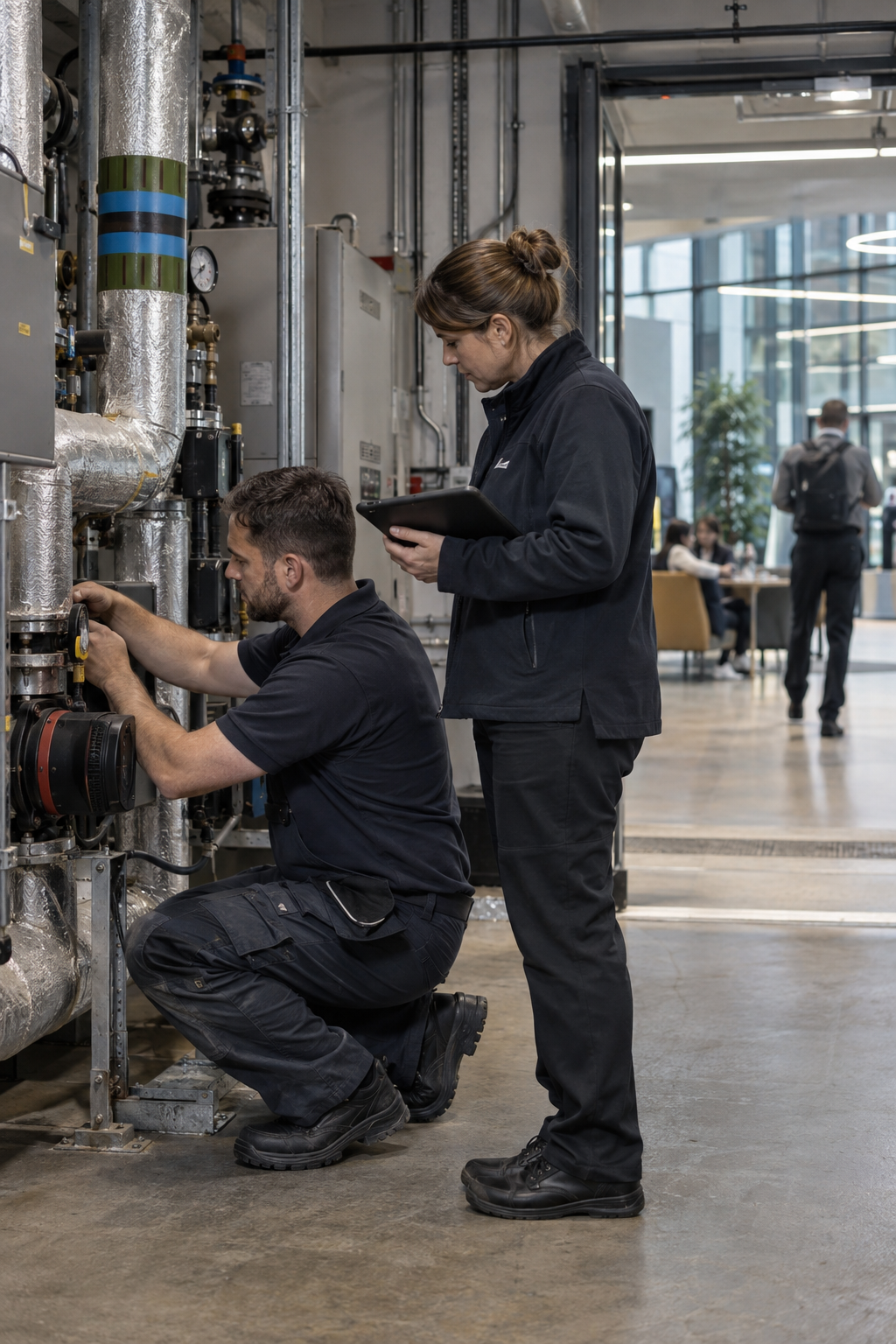
DBIM helps strengthen the management system around the work, while appropriately competent engineers, contractors and technical specialists continue to provide the specialist services the facility needs.
Facilities Management happens in the background of everybody else's working day.
Planned jobs, contractor visits, occupants, cleaning, waste, inspections and the occasional unexpected breakdown all compete for attention. The challenge is keeping control without getting in the way of the workplace you're there to support.
Contractors and workplace services begin before much of the building is occupied.
Access, welfare, shared spaces and normal building services need to work around occupants and visitors.
Access, information, work areas and interactions with normal business activity need coordinating.
The scope wasn't planned, people are affected and the pressure quickly shifts from prevention to getting the problem fixed.
The technical work may sit with the specialist, but access, coordination, information and follow-up still need managing.
Reports, defects, recommendations and certificates still need somewhere to go and somebody to own them.
The timetable above is illustrative, but the point is real: FM rarely manages one isolated risk at a time. Planned services, reactive issues, occupants and contractors overlap throughout the working day.
Good FM QHSE needs to work around that movement. The objective isn't to turn every task into a major process. It's to make sure the right amount of control appears when and where it's actually needed.

Planned work is easier to control. Reactive work tests the system.
A planned maintenance visit gives you time to understand the work, review arrangements and coordinate the activity. A breakdown arrives on its own timetable. Good FM controls need to remain usable in both situations.
Time to prepare.
The work and expected outcome can be defined beforehand.
Competence and appropriate documentation can be checked in advance.
Relevant building and task information can be identified and shared.
Access, occupants and other activities can be planned around the work.
Completion criteria and required records can be agreed before work starts.
Pressure arrives first.
The cause may not be understood until somebody investigates.
Availability may influence who can attend and how quickly.
Information may need gathering while the problem is already affecting people.
The failure may already have changed access, services or normal occupancy.
The pressure to restore service can make proper close-out easier to overlook.
Reactive doesn't have to mean uncontrolled. The system should already define the basic expectations around competence, access, building information, isolation, authorisation and handback before the phone rings.
Urgency changes the pace, not the standard. A proportionate FM system should help people respond quickly without having to invent the basic safety arrangements every time something unexpected happens.
FM doesn't just manage buildings. It manages interfaces.
Contractors rarely work in isolation. Their activity can affect the client, occupants, building services and other contractors. Good FM creates clear connections between all four.
Scope, priorities, responsibilities, service expectations and escalation need to be understood.
Competence, RAMS, access, permits, building information, isolation and handback need proportionate control.
Noise, access restrictions, temporary hazards, service interruptions and shared spaces need coordinating.
The work may interact with asbestos, electrical supplies, water systems, fire arrangements or other building services.
A register nobody checks can't protect the contractor opening the ceiling.
Asbestos is the obvious example. Relevant information on known or presumed ACMs needs to reach anyone whose maintenance work could disturb them, not simply exist in the building's compliance records.
The FM role is coordination, not pretending to hold every trade competency. The right contractor still provides the technical expertise. FM makes sure the work is properly connected to the building, the people using it and the management system around it.
Different services. The same management questions.
Facilities Management can range from complex building engineering to cleaning, waste and workplace services. The technical risks differ, but the need for ownership, competent delivery, evidence and follow-through doesn't.
The building and its systems.
Services concerned with physical assets, engineering systems, maintenance and the fabric of the premises.
The workplace and its services.
Services that support the people using the building and help keep the workplace operating effectively day to day.
One FM management approach.
Whether the supplier is maintaining an air-handling unit or cleaning a communal area, FM still needs an appropriate level of control around the service.
DBIM helps strengthen the management layer across both sides. Contractor arrangements, risk, environmental impacts, incidents, objectives, audits, actions and management systems can all sit across Hard and Soft FM services.
The level of control should remain proportionate to the risk and complexity of the service. A specialist engineering contractor and a routine workplace service shouldn't automatically be forced through an identical process.
You run the facility. DBIM strengthens the QHSE around it.
DBIM isn't there to replace the FM team or the specialist contractors delivering technical services. The role is to strengthen the controls, management systems and QHSE capability around the work.
Strengthen the practical controls around contractors, planned and reactive maintenance, permits, access, risk assessment, incidents and work affecting occupants.
Bring audits, objectives, environmental impacts, compliance obligations, recurring reviews and actions into a management system that supports rather than competes with FM delivery.
Add competent advice, independent review or ongoing QHSE capacity where the existing FM team needs expertise or additional resource behind it.
If the FM team already manages day-to-day H&S well, you may simply need competent advice available when questions arise plus an annual H&S Health Check.
The level of support should follow the need. A capable internal FM team may only need occasional advice. Another client may need help rebuilding contractor controls or regular Fractional QHSE support to keep improvement moving.
“Job complete” should mean more than the engineer has left site.
The physical work may be finished, but FM can still be left with certificates, defects, recommendations and follow-up actions. Proper handback connects the completed job back into the facility's management system.
The contractor confirms the agreed task has been completed and identifies anything outside the original scope.
Barriers, tools, temporary controls, waste and work areas are dealt with before normal occupancy resumes.
Isolations and temporary arrangements are removed or formally transferred, with affected services returned to the agreed condition.
Relevant reports, certificates, examination records, test results or servicing documentation reach the FM team.
Defects, recommendations and limitations don't remain buried halfway through a contractor report.
The required follow-up has an owner, priority and sensible route through to completion.
Asset, inspection or compliance records are updated so the next person isn't working from yesterday's information.
The loose ends after the job.
This doesn't mean every minor maintenance task needs a seven-stage bureaucracy. Handback should remain proportionate to the complexity, risk and compliance significance of the work.
Built for the people keeping places running.
DBIM works best where an FM team or service provider already understands the operation but needs stronger QHSE systems, competent advice or additional capacity behind it.
In-house FM teams
Managing an organisation's own buildings, contractors, maintenance programme and day-to-day workplace services.
Outsourced FM providers
Delivering facilities services into client environments where QHSE arrangements need to work alongside client requirements.
Hard FM providers
Engineering and maintenance-focused businesses managing planned, reactive and specialist building-services activity.
Integrated FM providers
Teams managing multiple Hard and Soft FM service streams where contractor and management-system consistency matters.
Multi-site organisations
Central FM or property functions needing common standards while retaining visibility of site-specific risks and actions.
Smaller businesses
Where Facilities Management sits with Operations, Office Management or another role rather than a dedicated FM department.
Practical QHSE that works around service delivery.
DBIM comes from an operational QHSE background, so the starting point isn't adding process for the sake of it. It's understanding how the facility runs, where the interfaces create risk and what level of control genuinely helps the FM team deliver.
FM operations with enough complexity that QHSE needs active management, but not necessarily enough scale to justify another full-time senior QHSE role.

What's sitting on the FM desk?
Start with the issue rather than trying to choose a consultancy package. If it's repeatedly consuming time, creating uncertainty or failing to close properly, that's a useful place to begin.
Different contractors, sites or managers are using different approaches to competence, RAMS, permits, access and handback.
Breakdowns and urgent jobs dominate the workload and the underlying FM QHSE arrangements need a wider review.
Contractor reports, inspections, certificates and recommendations exist, but responsibility and closure are becoming difficult to track.
Day-to-day arrangements are managed internally, but the team occasionally needs competent advice or an experienced second opinion.
You need common expectations across the estate without ignoring the different risks, contractors and services at each building.
The operation needs regular oversight, improvement capacity and support beyond what the existing FM team can comfortably absorb.
Raise the issue anyway.
Facilities Management rarely presents problems in neat consultancy categories. Tell us what keeps coming back, what's difficult to control or where the team needs support. We'll help identify the sensible next step and whether DBIM is the right fit.
What keeps landing on the FM desk?
Contractor issues. Reactive callouts. Open actions. Compliance questions. Reports nobody has had time to review. Or simply the feeling that too much depends on somebody remembering what needs doing next.
What's becoming difficult to control?
No hard sell and no unnecessary layers of process. Tell us what's causing friction in the FM operation. We'll help work out whether the answer is advice, improvement support, stronger systems or specialist input from somebody else.