
One brand. Multiple locations. Different risks every day.
Practical QHSE support that connects central standards with what actually happens locally.
DBIM supports retailers and multi-site businesses that need consistent Health & Safety expectations, clearer local ownership and better visibility of actions across locations. The objective isn't to make every site identical. It's to make sure the important things don't depend on the postcode.
Define clear expectations across the business.
Reflect the actual location, people and risks.
Test whether the standard works in practice.
Give findings an owner and route to closure.
Turn local findings into group-wide learning.
Policies, minimum requirements, reporting, audits and expectations give every location a clear common framework.
Layout, customers, employees, stock, contractors and building issues still need managing as they actually exist at each location.
Standardise the system. Localise the risk. Create common expectations without forcing every shop, showroom, branch or office to pretend it has exactly the same hazards.
The customer sees the shop floor. There's another workplace behind it.
Retail locations need to work for the people visiting them and the people operating them. Customers experience the public-facing space; employees also deal with deliveries, stock, waste, contractors and all the activity required to keep that space running.
Where customers meet the business.
The environment needs to remain safe and usable for people who may have no prior knowledge of the location.
Entrances, aisles, stairs and circulation routes need to remain obvious and usable.
Contamination, wet entrances and cleaning can quickly turn normal customer areas into slip risks.
Products and promotional material shouldn't introduce unstable fixtures, obstructions or avoidable trip hazards.
Queues, busy periods and difficult interactions need sensible management arrangements around employees.
Where the operation keeps moving.
Activities customers rarely see can introduce very different risks into exactly the same location.
Goods still need receiving, unloading and moving from vehicle to stockroom.
Storage, access, housekeeping and available space influence how safely employees can work.
Stock movement, handling aids and work at height still need managing around normal trading activity.
Repairs and servicing may happen while employees and customers continue using the premises.
Operational work doesn't stay behind the stockroom door.
Deliveries become replenishment. Cleaning moves onto the shop floor. Contractors enter customer areas. Waste travels back through the building. The controls need to follow the activity as it moves between employee-only and customer-facing space.
Retail Health & Safety has to work on both sides of the door. The public-facing environment may look simple, but it depends on a much wider set of operational activities being properly controlled behind it.

Your employees know the workplace. Your customers don't.
Employees can learn the layout, reporting routes and everyday hazards. Customers arrive with none of that knowledge and will naturally focus on why they're there. The environment should do as much of the safety work as possible.
Enter
Entrances need to remain usable through changing weather, customer volumes and deliveries.
Browse
Aisles, displays and customer routes should remain clear, stable and intuitive.
Queue
Busy periods can change normal circulation and create congestion around counters, equipment or exits.
Buy
Service activity should work around customers without introducing unnecessary handling or obstruction risks.
Leave
The route back through the premises and towards exits should remain clear and understandable.
Different mobility
People move at different speeds and may use wheelchairs, walking aids, pushchairs or other mobility support.
Different awareness
Customers may be concentrating on products, conversations, children or the person they are shopping with rather than looking for workplace hazards.
Different familiarity
First-time visitors do not know where steps, changes in level, toilets, lifts, exits or other features are located.
Different behaviour
Children, groups, queues and busy trading periods can create movement patterns the original floor layout did not anticipate.
A cone warns about the wet floor. It doesn't make the floor dry.
Wet entrances, spillages and cleaning are everyday retail issues. The useful control is to deal with the source, make the area safe and stop unnecessary access while the risk remains.
Warning signs still have a role, but they shouldn't become the entire response to something that can actually be removed or isolated.
The safest customer environment shouldn't require customers to understand your risk assessment. Clear routes, maintained floors, sensible displays and quick action on defects should make the safer choice largely intuitive.
Every product on the shelf had to get there somehow.
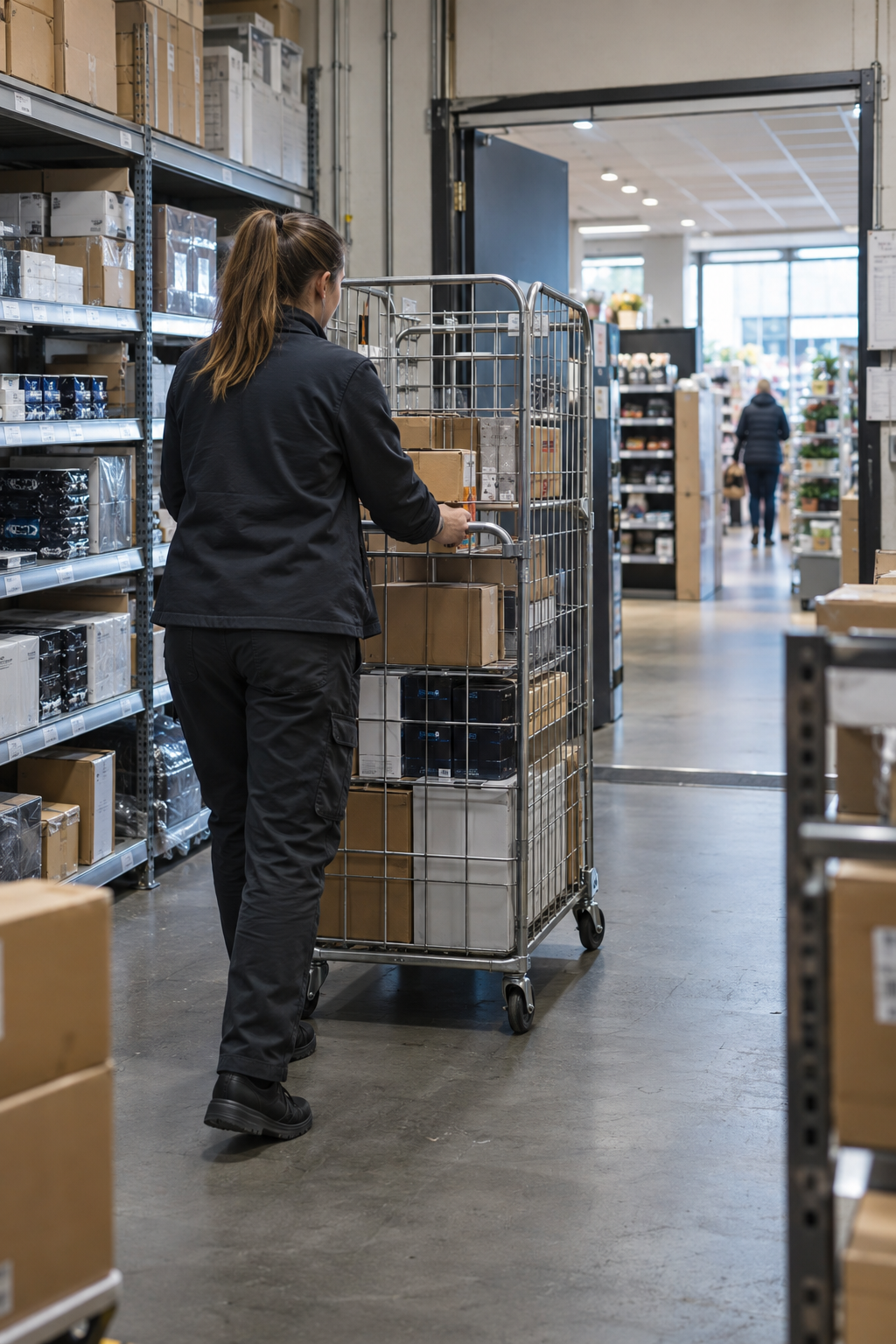
Retail manual handling doesn't only happen when the delivery arrives. Stock may be unloaded, moved, stored, picked and handled again before a customer ever sees it. The whole journey influences the risk.
Receive
Deliveries need a sensible place to arrive without immediately creating blocked routes, unstable stock or rushed handling.
Delivery · Space · VehicleMove
Trolleys, roll cages and other handling aids can reduce carrying, but still need suitable routes, condition and sensible loading.
Cages · Trolleys · RoutesStore
Stockroom layout and storage height influence how often people need to reach, bend, climb or move something twice.
Layout · Height · StabilityPick
Frequency matters. A relatively small load handled repeatedly can still create significant physical demand.
Frequency · Reach · GripReplenish
Stock reaches the customer environment, so handling, access equipment and customer movement may all need managing together.
Customers · Handling · HeightClear
Packaging, empty cages and waste still need somewhere safe to go without becoming the next obstruction or handling problem.
Waste · Packaging · HousekeepingStart with the task, not the training course.
First ask whether hazardous handling can be avoided or reduced. Can stock be delivered closer to where it's needed? Can a trolley or handling aid remove the carry? Can frequently moved products be stored somewhere easier to reach?
Training still matters, but shouldn't be used to compensate for a poor stockroom, unsuitable equipment or an unnecessarily difficult process.
Lifting, carrying, pushing, pulling, reaching and repetition.
Capability, experience and any relevant individual factors.
Weight, size, shape, grip and whether the product is stable.
Space, floor condition, storage height and customer activity.
The shop may still be open while the stock is moving. Larger replenishment tasks may need quieter times, temporary separation or a different route so employees aren't trying to manoeuvre stock around customers in unsuitable space.
A handling problem repeated across every delivery becomes a system problem. Look at how stock moves through the location before relying on individual employees to compensate for an awkward process.
Ordinary problems become incidents when nobody owns them.
A spill, damaged floor or blocked route doesn't need a complicated management system. It needs somebody to spot it, make the immediate situation safe and ensure the underlying problem doesn't quietly remain open.
Spill
A leaking product, drink or cleaning activity creates contamination in an area customers and employees still need to use.
Damaged flooring
A raised edge, damaged tile or other defect may remain manageable temporarily but still needs a clear route through to repair.
Stock in the route
Deliveries and replenishment can temporarily turn aisles, stockrooms or exits into storage space unless expectations are clear.
Wet entrance
Rain and footfall can change the condition of an entrance repeatedly throughout the trading day.
Defective fixture
Shelving, doors, equipment or displays can remain in service long after somebody first notices something isn't right.
Temporary workaround
A short-term control solves today's problem but gradually becomes the normal arrangement because the permanent fix disappears.
Make the response easy to repeat.
Employees shouldn't need to invent a new process every time something ordinary goes wrong. A simple route from immediate control to permanent closure makes the right response easier to repeat across locations.
When issues are recorded consistently, the central team can see patterns that one branch cannot. If the same floor defect, stockroom issue or replenishment problem keeps appearing across locations, the answer may be a group-level improvement rather than another isolated repair.
Don't confuse “made safe” with “fixed”. The immediate control protects people now. Good action management makes sure the underlying issue still reaches a permanent resolution.
Not every retail risk comes from the building.
Retail puts employees into contact with customers, contractors, busy periods and changing staffing levels every day. The arrangements need to work around people and interactions, not just floors, fixtures and stock.
New & young workers
People who are less familiar with work or the location may need clearer induction, instruction and supervision while they settle in.
Induction · Understanding · SupervisionTemporary & seasonal staff
Fast onboarding during busy periods shouldn't mean assuming somebody already understands the location, procedures or expectations.
Information · Role · ReportingLone workers
Opening, closing, quieter trading periods or work elsewhere on the premises can leave people without close or direct supervision.
Contact · Monitoring · Emergency · SupportCustomer-facing employees
Complaints, refusal of service, suspected theft or other difficult interactions can expose employees to abuse, threats or aggression.
Violence · Escalation · Support · ReportingLocal managers
Managers need enough authority and clarity to deal with local issues without being expected to become Health & Safety specialists.
Ownership · Escalation · CompetenceContractors
Maintenance, repairs and servicing may take place around customers and employees, requiring coordination with the local operation.
Information · Coordination · SeparationCustomer service shouldn't mean accepting abuse as part of the job.
Abuse, threats and assault connected with work are Health & Safety risks that need managing, not simply difficult customer-service moments.
The arrangements should help employees recognise when to disengage, how to get support, where to report incidents and what happens afterwards.
A branch manager shouldn't need to solve every unusual H&S question alone. Clear escalation routes and access to competent advice help local people deal with what they can control and know when something needs specialist or central support.
People need more than a procedure. The system should give employees practical information, clear boundaries, appropriate support and confidence that reporting a problem will lead somewhere useful.
Central standards only work when they survive contact with the branch.
A group needs enough consistency to know what good looks like, while each location still needs to manage the risks in front of it. The best multi-site systems connect central expectations, local ownership and group-wide visibility.
Set the standard.
Define the expectations that should not have to be reinvented independently at every location.
Own the location.
Apply the common framework to the risks and conditions that actually exist at that branch.
See the pattern.
Bring local information together so the business can understand what individual branches cannot see on their own.
Standardise the system. Localise the risk.
The policy, inspection method and action process can be common. The risk assessment still needs to reflect the actual location. A city-centre shop, retail park showroom and warehouse-backed branch may all belong to the same company without being identical workplaces.
Branch A reports damaged flooring. Branch B raises the same issue. Branches C, D and E follow. The question is no longer only whether each repair gets completed. It's whether specification, maintenance, inspection or another group-level issue needs addressing.
Good central oversight shouldn't remove local responsibility. It should make it easier for branch managers to understand what they own, easier to escalate what they don't, and easier for the wider business to learn across locations.
Different locations. One business to manage.
DBIM works best with retail and multi-site businesses that need clearer standards, stronger local ownership and better visibility of what's happening across the group, without creating an oversized corporate system that branches struggle to use.
Retail groups
Several stores operating under one brand where common expectations need to work across different locations, teams and building types.
Growing retailers
Businesses moving from a handful of locations to a larger network where informal systems are becoming difficult to manage centrally.
Showrooms
Customer-facing premises combining displays and public access with stock, deliveries, maintenance and operational activity behind the scenes.
Service branches
Networks of local branches where employees interact with customers while also managing workplace, stock and contractor issues.
Franchise-style networks
Businesses needing clear central expectations and assurance while day-to-day control sits with local operators.
Wider multi-site businesses
Branch, office, depot or mixed-location organisations that need one QHSE framework with enough flexibility for different local risks.
Practical enough for the branch. Structured enough for the group.
DBIM combines operational QHSE, ISO management systems and continual improvement with a practical approach to digital systems. That means helping businesses build standards people can follow, actions managers can own and information the central team can actually use.
Where appropriate, DBIM can help translate the management approach into simple Microsoft 365-based workflows for inspections, actions and central visibility, reducing reliance on disconnected spreadsheets, emails and branch-specific trackers.
The aim isn't to centralise every decision. It's to make the important standards consistent, give local managers clear ownership and make sure the wider business can see where support or improvement is needed.

What can you see across the locations?
You don't need to redesign the entire Health & Safety system before asking for help. Start with the inconsistency, recurring issue or visibility gap you can already see.
You need an independent view across a representative group of locations to understand what is consistent, what varies and what needs attention centrally.
The business needs common standards, clearer local ownership, consistent inspections and a single route for reporting, escalation and action management.
Local actions are being completed, but similar issues continue elsewhere and the group needs to understand the common cause.
Branches can see their own issues, but the wider business lacks one reliable view of ownership, target dates, evidence and overdue actions.
Local managers can handle everyday issues but need a clear second line of support when something unusual or uncertain arises.
The business needs regular audits, action management, reporting and improvement support beyond the capacity of the existing central team.
Start with what you can't currently see.
Maybe you don't know whether inspections are consistent. Maybe actions disappear after audits. Maybe one location performs well while another repeatedly struggles. That lack of visibility is useful information in itself. DBIM can help work out what needs standardising, what belongs locally and what the central team genuinely needs to know.
One business shouldn't mean twenty versions of Health & Safety.
Set the important standards centrally. Give local managers clear ownership. Keep actions visible. Learn from what's happening across the group. Then let each location manage the risks that genuinely belong to that location.
Where is the multi-site system creating friction?
No generic branch pack and no unnecessary corporate bureaucracy. DBIM can help build a proportionate system around your locations, managers and existing Microsoft 365 environment, from competent advice and audits through to action tracking and ongoing QHSE support.